Tuesday, February 24, 2026

NC State Archives highlights collections added in 2025 in a new video

A new video is available from NC State Archives highlighting new collections added in 2025. The video also introduces our new State Archivist, Kelly Policelli. 

Highlighted collections include new records about Black Mountain College, additions to the oral history and photograph collections, new military correspondence, and ways to access these records online. Featured collections are housed within the Raleigh , Outer Banks and Asheville branches of the archives. 


Visit Wake County Genealogical Society's Website - Homepage | WCGS Events | Join WCGS | Publications | Wake Cemetery Survey Images | Society Surnames | Digital Resources | History Resources | More Links and Resources |  Donate | Contact - info(at)wakecogen(dot)org

Saturday, February 21, 2026

Wake County Publications Available - Visit Wakecogen Lulu.com

The Wake County Genealogical Society is the author of eight books containing Wake County ancestors.

Order your own copy!

School Census – Raleigh Township 1897
Cost: $11.69

Wake County Apprentice Bonds, 1770-1860 and 1872-1903
Cost: $28

Wake County Bastardy Bonds – 1772-1937
Cost: $20

Wake County Deed Book R [March 1802-October 1803]
Cost: $20

Wake County NC - Divorce Records A-M
Cost: $32

Wake Co. Superior Court Divorce Records 1831-1920, SURNAMES N-Z
Cost: $17

Wake County, NC Levy Dockets 1805-1815
Cost: $17

Wake Heritage
Cost: $55

Find details of each volume at  our website on the Publications page  (scroll down for Lulu).

Find the prices and place your order on Lulu.com. Use the following search to see only the eight books being offered by Wake County Genealogical Society.

Browse and  purchase from our Lulu Collection.


Visit our Lulu Collection for more


Visit Wake County Genealogical Society's Website - Homepage | WCGS Events | Join WCGS | Publications | Wake Cemetery Survey Images | Society Surnames | Digital Resources | History Resources | More Links and Resources |  Donate | Contact - info(at)wakecogen(dot)org

Wednesday, February 18, 2026

Wake Wednesday 250 - Early Maps colonial and post-Revolutionary War era

The map mentioned in the Jumonville Glen post is so useful for visualizing population, location and proximity during colonial times, I wanted to give it its own searchable post. To distinguish from the earlier post, here is a close up of the North Carolina section. I have put a rough sketch of the modern borders in blue to help you get your bearings. Notice how wild it all is. 

There are only a few recognizable towns along the coast at this point.  I see Bath, Beaufort, and New Bern. There is no Wilmington, Halifax, or Hillsborough. There was definitely no Wake County or Raleigh yet. A town I have never hear of at all is also located at the coast. That would be Soroacte on this map, also called Sarecta the first charted town of Duplin County. At that time, Sarecta was a hamlet of ten houses. You can read about the town's early history here.

Open map to original size for best viewing
Excerpt from the 
Carte des possessions angloises & françoises
du continent de l'Amérique Septentrionale, 
c.1755
Source link -  see full image below
Outline source  - North Carolina State Outline Vectors by Vecteezy

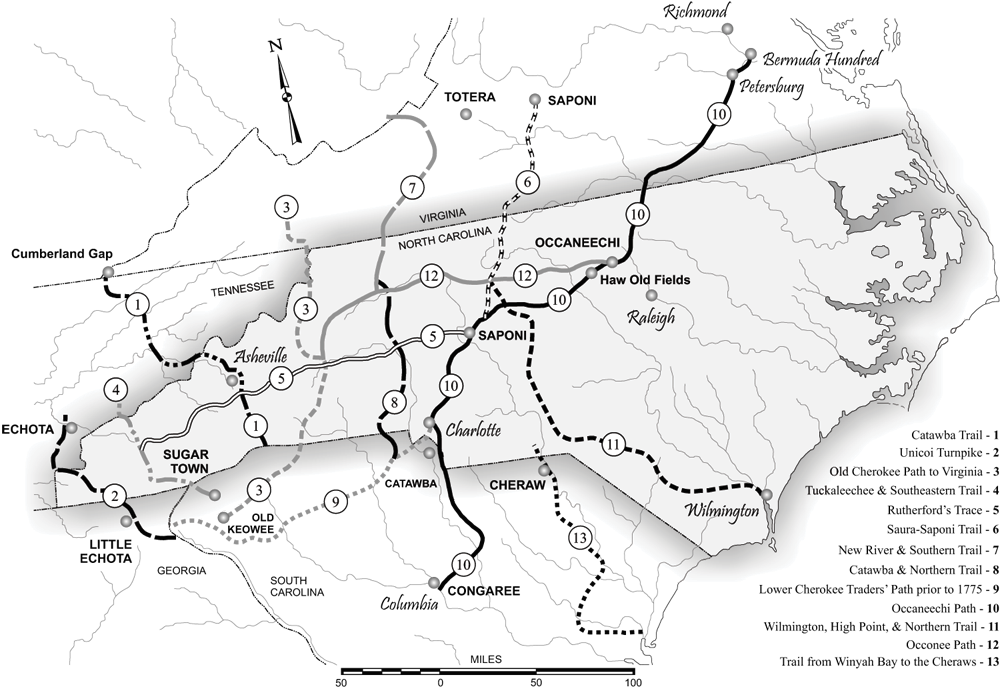
The big three roads of the day are represented. The Kings Highway snakes along the coast. The Natuve Trading Path winds south diagonally from the Virginia line in a lazy S-shape that turns westward at the South Carolina border. The Great Wagon Road enters our state at the northern border at the Dan River just east of the native village of Saura Town. It travels nearly due south and crosses the Native Trading Path befor veering southeast to the coast. 

The rivers on this map are its best landmarks. Even so, I struggled to get perspective on just how a modern outline would fit over it. It the process of that struggle, I found another map that helped immensely. It was not much newer but there were enough recognizable town names and very close foot print to the NC borders of today. It helped me finally knit the 1775 Carte des Possessions map and the modern borders together.

Meet The State of North Carolina from the best Authorities by John Reid, c. 1796. What a difference a revolution and forty years makes. This map includes many recognizable counties, and familiar towns and roads have sprung up everywhere. You have to squint hard to see the remnants of the Native Treading Path, but it is there. There is even Wake County and Raleigh right where you want to see them at the ripe old age of 20 years. Have a look. The link will take you right to this stunning map. Enjoy all its great reference points. If you look just under Iredell County, you will see Fort Dobbs'  location referenced in the last post.

Open map to original size for best viewing
The State of North Carolina from the best Authorities by John Reid, 1796
Source link 

Here is the full view of the Carte des Possessions map. 

Source link - Be sure to expand to full screen for best viewing.

I am sure once you have had a chance to spend some quality time with your colonial ancestors and these maps, you will grow to appreciate them as much as I do. There are so many ways you can use them to inform and illustrate your research. Be sure to stash the links in your own research log for safe keeping. Enjoy!

Visit Wake County Genealogical Society's Website - Homepage | WCGS Events | Join WCGS | Publications | Wake Cemetery Survey Images | Society Surnames | Digital Resources | History Resources | More Links and Resources |  Donate | Contact - info(at)wakecogen(dot)org

Tuesday, February 17, 2026

Special Black History Month Presentations - Shiloh and Jesse Harris, Rev War Soldier

excerpt from SOFAFEA newsletter -

Saundra Russ Cropps, WCGS Diversity Officer and member of the South Atlantic Region of Society of the First African Families of English America, presented at the Afro-American Historical and Genealogical Society-Triangle Chapter on February 7. She shared the story of her Forgotten Patriot ancestor Private Jesse Harris and the Shiloh Missionary Baptist Church (from the original project collaboration with the Wake County Historical Society and Wake County Genealogical Society). Russ Cropps shared the story of her ancestor Private Jesse Harris (1762-1844), a free Black man who served for 18 months in the 10th North Carolina Regiment of the Continental Army after being hired by a "class of men" to fulfill their service obligation.

Saundra Russ Cropps

Black History Month is a fitting time to share both presentations from our Shiloh History Celebration in October 2025.
 
View both slidesdecks with narrative below:
   
      Resources
      Descendants


Visit Wake County Genealogical Society's Website - Homepage | WCGS Events | Join WCGS | Publications | Wake Cemetery Survey Images | Society Surnames | Digital Resources | History Resources | More Links and Resources |  Donate | Contact - info(at)wakecogen(dot)org

Monday, February 16, 2026

Upchurch and Allied Families Association Newsletter - February 2026

For those following along, here is the latest Upchurch and Allied Families Association Newsletter.


Visit Wake County Genealogical Society's Website - Homepage | WCGS Events | Join WCGS | Publications | Wake Cemetery Survey Images | Society Surnames | Digital Resources | History Resources | More Links and Resources | Contact - info(at)wakecogen(dot)org

Reminder! 2026 Wake County Genealogical Society Virtual Meetings - next - Feb 24, 2026

There is still time to register for this webinar. Who knows what you will find in the digital collections.


Tuesday, Feb. 24, 2026 @ 6:30pm – Virtual 

Topic: NC Archives Digital Services: Using the website, digital collections, and online catalog

Speaker: Anna Peitzman

Join us for a review of the digital resources offered by the State Archives! Topics will include: Navigating the SANC website, searching the North Carolina Digital Collections, and searching the Discover Online Catalog, otherwise known as DOC.
 
 Join us!  Free and virtual!

*Please register by 4pm day of meeting.

*Please save your passcode and link for ease of entry at start time.

*Presentation starts promptly at 6:30 pm.


Link to register at the Wakecogen website events page. 

Registration is now open!

**Get the video recording to watch on-demand for 30 days and access to our webinar handout library with your WCGS membership!**

        ** At presenters discretion.


Upcoming Events 

View events page for details 

Tuesday, Mar 24, 2026 @ 6:30pm - Virtual
Who's your daddy? Exploring North Carolina Bastardy Bonds 
presented by A. Danielle Pritchett, MLS

Tuesday, Apr 28, 2026 @ 6:30pm - Virtual
Researching Your Mom: Don't overlook researching your immediate family!  
presented by Diane L Richard

Tuesday, May 26, 2026 @ 6:30pm - Virtual
Preserving Small Family Cemeteries
Presented by Joel Hobby 

Tuesday, Jun 23, 2026 @ 6:30pm - Virtual
Fishing in Every Pond: Cousin Baiting
presented by Christine Cohen


Visit Wake County Genealogical Society's Website - Homepage | WCGS Events | Join WCGS | Publications | Wake Cemetery Survey Images | Society Surnames | Digital Resources | History Resources | More Links and Resources |  Donate | Contact - info(at)wakecogen(dot)org


Wednesday, February 11, 2026

Wake Wednesday 250: John Chavis, Notable Black Educator, preacher and Rev War Soldier

This article was previously posted in our newsletter, Wake Genealogy Watch, Vol 6.4, Summer 2023 under the title A Useful Find: NC Schools & Academies, 1790-1840. 

I often discover interesting records by accident as I am researching other things. I found a lot that I was not looking for as I researched things for the Wake Cemetery Survey. This record is one you will find interesting if you have early NC ancestors. - CD 

You will find a digitized copy of North Carolina Schools and Academies, 1790-1840, A Documentary History at NCDigital for your research and browsing pleasure. Created by Charles Lee Coon and published in 1915, “North Carolina Schools...” is a collection of education related postings that appeared in the weekly Raleigh Register during the 1790-1840 time frame. The book is an attempt to portray education as it existed in North Carolina during the fifty years immediately succeeding 1790. 

While the volume covers all NC counties of that time, I focused on browsing Wake County. It should be noted that one must add 50 to any page you choose in the table of contents if you wish to land on the correct page. The front matter was numbered with roman numerals and that shifts the page numbering out of line considerably. The Table of Contents starts on page 51. The Wake County index includes pages 54 and 55. Schools appear to be listed in the order in which they were created chronologically from 1809- 1839. A more readable copy of each page appears by clicking on the preview window of the page you have chosen. A higher resolution image will appear. Raleigh Academy, the largest school in the area, appears on pages 388 (438) -512 (562). 

John Chaves’ school of Wake County highlighted below caught my interest as I read that the school catered to both white children and children of color. The free colored population of Raleigh at this time must have been large enough to support this. I wondered if there was more to find on this school. 


Source.
Click image to enlarge text.


I went looking and did find several articles about the teacher, John Chavis (Chaves). A lengthy article at NCPedia summarized his life. He was a brave and accomplished man who certainly earned his historical marker located at East and Worth Streets (if not more). 

He was probably an "indentured servant” of John Milne of Halifax (c. 1773). He was a soldier in the Rev War, educated at the Presbyterian Washington Academy (now Washington and Lee University) and at Princeton. He was a licensed Presbyterian minister, and described as "almost certainly the most learned black of his time in the South, and perhaps in the United States." 

His school in Wake started in 1808 was still running in 1828. He taught in Granville and Chatham counties as well. His bio is a good read. 

I went to school with many Chavis kids at Millbrook High School back in the day. I imagine they were probably descendants. I wonder if they knew of their inspiring ancestor. I hope so, and wish we had been taught his role in history. It is amazing what you find when you are not looking for something. Check out NC Schools and Academies online and see what you learn. - CD


Visit Wake County Genealogical Society's Website - Homepage | WCGS Events | Join WCGS | Publications | Wake Cemetery Survey Images | Society Surnames | Digital Resources | History Resources | More Links and Resources |  Donate | Contact - info(at)wakecogen(dot)org

Wednesday, February 4, 2026

Wake Wednesday 250 - The Jumonville Glen Incident, May 1754

AKA - That time George Washington might have started the first Global War!

Let's look at the territories in the time leading up to the French and Indian War. The map below illustrates the land held by the various parties at this time. France in green, Native Americans in pink and Britian in gold. 

The maps set the stage for the events and pressures of the day. In this 1755 map, the English colonists were pushing westward for more fertile farm land, the French were pushing eastward to meet the English before they could claim land that France wanted for themselves, and the Native tribes resented being pushed on both sides. They wanted desperately to hold their ground and maybe gain back a little of what they had lost. The Natives were frequently bargaining with whichever side had the upper hand. It was a volatile time for all.

Carte des possessions angloises & françoises du continent de l'Amérique Septentrionale
c.1755
Source link - click to enlarge


Comparing this map (link) of the Native Trading Path Road through Va., NC, and SC will help you get your bearings on the 1755 map. The line that snakes from Petersburg, Va through NC into SC is this same Trading Path Road.

George was in his early twenties at this time and serving as a soldier for Britain as many good colonists of the day would do. In response to a spate of fort building along Lake Erie and LeBoeuf Creek, Virginia Governor Robert Dinwiddie directed Lt. Col. George Washington, his men and a band of Ohio Indian co-horts to lead a diplomatic mission to encourage the French to take a beat and abandon their forts. Washington was very green as an officer. He had only joined the militia a year earlier. The governor chose Washington thinking his prior six years experience as a surveyor would help in navigating the frontier. Alas, the mission did not end well and things deteriorated further over the ensuing year.

I won't deprive you of a wonderful account that describes diplomatic mission and the ensuing events. I recommend you read this article from Smithsonian magazine that chronicles Washington's experiences and missteps that led to the opening battle of the French and Indian War. The most amazing part of the article is the eye-witness account of a Native called the "Chief Warrior of the Ohio Iroquios." It is not often we get that sort of direct insight into how colonists and Natives were interacting in the moment.
We are all Soldiers and Warriors. Some sharp words will now pass between us. We shall talk like drunken Men.”  
Chief Warrior of the Iroquois

Read the article here - When Young George Washington Started a War by Allison Shelley

As stated in the last blog post, the French and Indian War was part of a larger global conflict. The incident at Jumonville Glen was the spark that ignited the fire. For folks closer to home in NC, these actions spawned an immense rift between Natives and settlers. The frequency and intensity of Native attacks on settlers, resulted in the establishment of Fort Dodd near modern Winston-Salem. Colonists retreated eastward to Ft. Dodd and Bethabera putting strain on those populations and causing an epidemic due to overcrowding. 

It is interesting that Washington was an instigator, if maybe only an accidental one, at the outset and our Founding Father at the conclusion. This article presents a fuller picture of George Washington that we get from most stories handed down. He was more human than "larger than life" I fear.


Visit Wake County Genealogical Society's Website - Homepage | WCGS Events | Join WCGS | Publications | Wake Cemetery Survey Images | Society Surnames | Digital Resources | History Resources | More Links and Resources |  Donate | Contact - info(at)wakecogen(dot)org