
 |
| Source |
The Regulator Movement in North Carolina (mid‑1760s to 1771) grew out of everyday frustrations that many backcountry families experienced with taxes, courts, and local officials. After the French and Indian War, the British Empire tightened control and raised revenue, but in North Carolina the most pressing issue for ordinary settlers was how provincial and county officers applied those taxes and fees on the ground. For many small farmers in counties like Orange and the areas that would become Wake, the problem was not abstract British policy so much as very concrete abuses at the courthouse and in the sheriff’s office.
Inequality: East vs. Backcountry
A sharp divide separated wealthy planters and officeholders in the eastern counties from the poorer settlers in the Piedmont backcountry. Eastern elites dominated the Assembly and high offices; they set policies and often backed their own network of appointees. Backcountry farmers, working thinner soils and living far from coastal towns, felt that they bore similar tax burdens without equal influence. This imbalance of power made each new levy, fee, or lawsuit feel like part of a broader pattern in which government served the rich and well‑connected first.
Corrupt Local Officials
At the county level, corruption made that inequality painfully visible. Sheriffs, tax collectors, court clerks, and lawyers exercised wide discretion over how much they charged and how they enforced the law. There were no clearly posted fee schedules in most places, so ordinary people often had no way to know whether what they were being charged was legal or inflated. Common abuses included collecting more tax than the law allowed and keeping the difference, padding accounts, falsifying records, and seizing property when people could not pay in scarce cash. Those seized goods were then auctioned, sometimes under conditions that allowed insiders and friends of officials to buy property at a fraction of its value. In several Piedmont counties, including Orange, small “courthouse rings” of allied officials and lawyers effectively controlled local government, protected each other from complaints, and turned officeholding into a source of personal profit.
The Regulators Wanted ... Regulation!
Settlers who began calling themselves “Regulators” believed that government itself needed to be regulated. They were not, at least at first, arguing for independence from Britain or the overthrow of the colonial order.
Instead, they demanded clear and public laws on taxes and fees, honest enforcement, the removal or punishment of corrupt officials, and better representation in provincial decision‑making for backcountry communities. The tools they first chose were conventional and legal: petitions to the governor, public meetings, and attempts to work through the courts. Only when these avenues seemed blocked, and when abuses continued, did some Regulators turn to more confrontational tactics. They started refusing to pay disputed taxes and fees, disrupting court sessions, and assembling with arms.
Loyal but Angry
Throughout this period, most Regulators described themselves as loyal subjects of the king who were seeking redress and reform, not separation from “king and country.” In that sense, their movement differs from the later American Revolution, even though both involved resistance to arbitrary or unjust power. The Regulators’ quarrel focused on how power was used in North Carolina—by sheriffs, clerks, and provincial officers—rather than on whether the British crown had any authority at all.
Orange County Support
Support for the Regulation was especially strong in Orange County. Contemporary estimates and later accounts suggest that out of roughly 8,000 inhabitants, perhaps 6,000–7,000 were sympathetic to or supportive of the Regulators, though these numbers are based on observers’ claims and cannot be verified precisely. Even so, they capture the sense that in Orange County the movement was not a fringe rebellion but a majority feeling among small farmers and tradespeople.
Grievance Ends in Armed Conflict
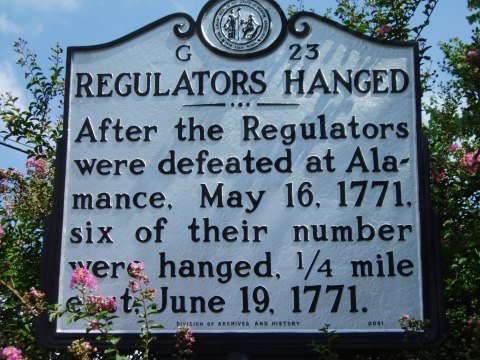 |
| source |
Reckoning With The Regulators -A Deeper Look at the Battle of Alamance -
Includes all the Regulator "Advertisements" (their petitions of grievances) as well as letters between Regulator Leaders and British officials. Many Regulators signed the Advertisements. It's a genealogical bonus if you find an ancestors name there!
Regulator Movement at NCPedia
Regulator War - American Battlefield Trust
The Battle of Alamance - American Battlefield Trust
Wake County's History - Joel Lane Museum House
Carolina Regulator Movement - EBSCO
Notable Regulators (with profiles of leaders) - Wandering Through the Piedmont
Visit Wake County Genealogical Society's Website - Homepage | WCGS Events | Join WCGS | Wake Genealogy Watch Newsletter | WCGS Facebook | Wake Cemetery Survey Images | Resources | Contact - info(at)wakecogen(dot)org
Comments
Post a Comment